


Dynamic Slippage Model of the Earth’s Coating by Bogdan Jacek Góralski
Abstract and Keywords — Dynamic Slippage Model of the Earth’s Coating
Dynamic Slippage Model of the Earth’s Shell
Shell=Earth’s coating=crust + mantle
Hypothesis by Bogdan Jacek Góralski
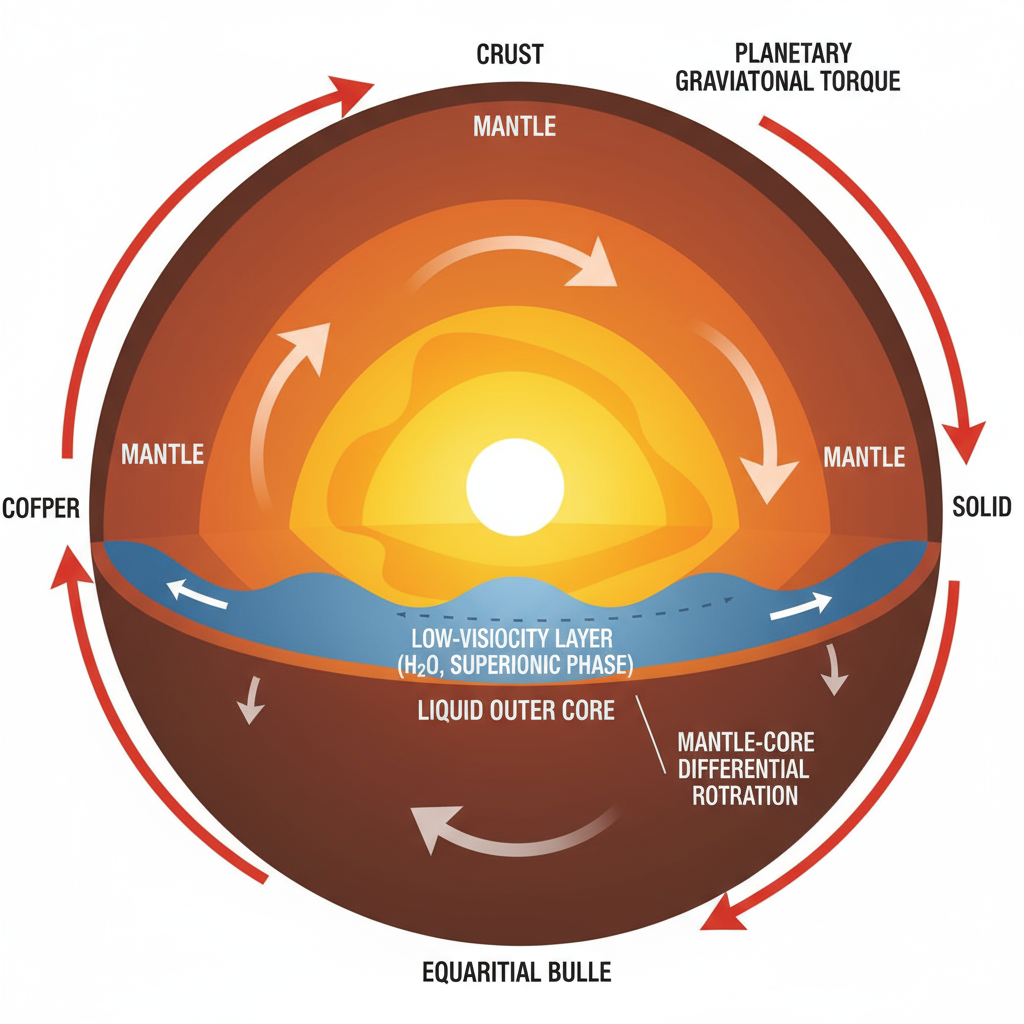
Abstract
This paper presents a conceptual model linking the dynamics of the Solar System with long‑term changes in the Earth’s internal rotation.
According to the hypothesis, periodic gravitational torques generated by cyclic planetary configurations (especially the Jupiter–Saturn resonance) act upon the Earth’s equatorial bulge.
These variable torques induce the exchange of angular momentum between the mantle–crust shell and the liquid outer core, enabling a slow, periodic slippage of the shell along the core–mantle boundary (CMB).
Under extreme pressures (>120 GPa), hydrous minerals at the CMB may release water, forming a superionic or vapor-like low‑viscosity layer that acts as a lubricant.
This facilitates differential motion of the shell relative to the metallic core.
The model provides a new perspective on geodynamic and climatic cycles by integrating external planetary forcing with internal terrestrial responses.
It predicts that planetary torque maxima correspond to variations in Earth’s rotation rate, oscillations of magnetic field intensity, and subtle reorganizations of mantle flow that could influence long‑term climate trends.
Further verification of this hypothesis requires combined astronomical, geophysical, and mineral‑physics studies focusing on:
- correlations between planetary alignments and Length‑of‑Day variations,
- electromagnetic anomalies at the CMB detected through geomagnetic data, and
- laboratory evidence of hydrous superionic phases under core–mantle boundary conditions.
Keywords
planetary gravitational torque • Earth rotation • core–mantle coupling • CMB low‑viscosity layer • superionic water • angular‑momentum exchange • geodynamical resonance • secular variation of geomagnetic field
Short Summary
The Dynamic Slippage Model explains possible periodic motion of the Earth’s outer shell relative to the core as a response to external gravitational forcing from the Solar System.
Planetary alignments generate small but cumulative torques acting on the Earth’s equatorial bulge.
Over long time intervals, these torques exchange angular momentum between the core and the mantle.
Friction at the boundary—potentially reduced by a hydrous or vapor‑like layer—permits a slow, quasi‑periodic slippage, which could be responsible for subtle but globally significant geophysical and climatic variations.
Dynamic Slippage Model of the Earth’s Shell — Hypothesis by Bogdan Góralski
Dynamic Slippage Model of the Earth’s Shell
Hypothesis by Bogdan Góralski
1. Introduction
The Earth consists of an inner core, a liquid outer core, a mantle, and a crust forming the outer shell.
This hypothesis proposes that the Earth’s shell (mantle + crust) may periodically slide over the boundary separating it from the liquid outer core, as a result of variable gravitational torques generated by the Sun, Moon, and planets.
2. Physical Foundations of the Hypothesis
2.1. Planetary Gravitational Torques
Cyclic configurations of the planets (orbital resonances such as Jupiter–Saturn ~20 years, long cycle ~900 years) periodically amplify the total gravitational field.
The total torque acting on the Earth’s equatorial bulge can be approximated as:
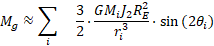
where: – mass of the planet,
 – distance between the planet and Earth,
 – Earth’s oblateness coefficient (≈ 1.08×10⁻³),
 – equatorial radius (6 378 km),
 – angle between Earth’s equatorial plane and the planet’s gravitational vector.
This varying external torque acts with a lever arm roughly equal to half of Earth’s equatorial radius, producing periodic accelerations and decelerations of the shell’s rotation.
2.2. Exchange of Angular Momentum Between Core and Mantle
Changes in the rotational momentum of the Earth,  , cause the exchange of angular momentum between the mantle and the core:

where  ,
,  are the respective moments of inertia of the mantle and core.
This process leads to oscillations of their relative rotation rates, resulting in microscopic slippage at the interface.
2.3. Low-Viscosity Layer at the Core–Mantle Boundary (CMB)
The core–mantle boundary (CMB, at ≈ 2 890 km depth) may contain hydrous minerals and their decomposition products, which under pressures >120 GPa form a mixture of hydrogen, oxides, and superionic water.
This mixture behaves as a lubricant of low viscosity, allowing relative motion:


where  – viscosity, and
  – velocity gradient between the core and the mantle.
3. Mechanism of the Shell Slippage
Planetary gravitational torque variations → exchange of angular momentum → slippage on the high-pressure steam layer:
PLANETARY CONFIGURATIONS
(Jupiter–Saturn–Earth cycles)
↓
Variable external gravitational torque
↓
+—————————-+
| EARTH’S OUTER SHELL |
| Crust + Mantle |
| (lower density, reactive)|
+—————————-+
||
|| ← Low-viscosity layer (H₂O, superionic phase)
||
+—————————-+
| LIQUID OUTER CORE |
| (Fe–Ni alloy, inertia) |
+—————————-+
↓
INNER CORE
As a result, the Earth’s shell slowly slides over the core, which can manifest as:
- long-term variations in the length of day (LOD),
- polar drift and nutation (changes in Earth’s rotation axis),
- modulation of the geodynamo due to variations in heat flux at the CMB.
4. Conclusions and Predictions
- Periodic variations of Earth’s rotation and differential core–mantle rotation correlate with planetary cycles.
- Groupings of massive planets on one side of the Sun amplify the gravitational torque on Earth’s equatorial bulge.
- A vapor- or hydrate-rich film under extreme pressure facilitates microscopic slippage between layers.
- Over geological timescales (10⁶–10⁸ years), these small effects accumulate, potentially shifting Earth’s rotational axis and reorganizing magnetic field patterns.
5. Methods of Verification
- Search for correlations between planetary configurations and variations in Earth’s rotation (LOD, Chandler wobble).
- Modeling electromagnetic and seismic properties indicative of a low-viscosity layer near the CMB.
- Laboratory experiments on hydrous mantle rocks under high pressures to confirm potential formation of superionic water phases.
6. Summary
The hypothesis of the Earth’s shell sliding on a layer dominated by high-pressure water derivatives offers a new framework linking external planetary gravitation with internal geodynamics.
Cyclic gravitational torques from the Solar System could modify Earth’s angular momentum and conditions at the CMB, initiating slow but global displacements of the outer shell relative to the core.
Note (for use in Word):
- Paste as Keep Text Only to maintain formatting.
- Set diagrams in a monospaced font (e.g., Consolas or Courier New).
- Use Word drawing tools to highlight flow directions or layer separations.
Wygenerowane przez GPT-5
Dynamic Slippage Model of the Earth’s Shell — Hypothesis by Bogdan Góralski
Dynamic Slippage Model of the Earth’s Shell
Hypothesis by Bogdan Góralski
1. Introduction
The Earth consists of an inner core, a liquid outer core, a mantle, and a crust forming the outer shell.
This hypothesis proposes that the Earth’s shell (mantle + crust) may periodically slide over the boundary separating it from the liquid outer core, as a result of variable gravitational torques generated by the Sun, Moon, and planets.
2. Physical Foundations of the Hypothesis
2.1. Planetary Gravitational Torques
Cyclic configurations of the planets (orbital resonances such as Jupiter–Saturn ~20 years, long cycle ~900 years) periodically amplify the total gravitational field.
The total torque acting on the Earth’s equatorial bulge can be approximated as:
where: – mass of the planet, – distance between the planet and Earth, – Earth’s oblateness coefficient (≈ 1.08×10⁻³), – equatorial radius (6 378 km), – angle between Earth’s equatorial plane and the planet’s gravitational vector.
This varying external torque acts with a lever arm roughly equal to half of Earth’s equatorial radius, producing periodic accelerations and decelerations of the shell’s rotation.
2.2. Exchange of Angular Momentum Between Core and Mantle
Changes in the rotational momentum of the Earth, , cause the exchange of angular momentum between the mantle and the core:
where , are the respective moments of inertia of the mantle and core.
This process leads to oscillations of their relative rotation rates, resulting in microscopic slippage at the interface.
2.3. Low-Viscosity Layer at the Core–Mantle Boundary (CMB)
The core–mantle boundary (CMB, at ≈ 2 890 km depth) may contain hydrous minerals and their decomposition products, which under pressures >120 GPa form a mixture of hydrogen, oxides, and superionic water.
This mixture behaves as a lubricant of low viscosity, allowing relative motion:
where – viscosity, and – velocity gradient between the core and the mantle.
3. Mechanism of the Shell Slippage
Planetary gravitational torque variations → exchange of angular momentum → slippage on the high-pressure steam layer:
PLANETARY CONFIGURATIONS
(Jupiter–Saturn–Earth cycles)
↓
Variable external gravitational torque
↓
+—————————-+
| EARTH’S OUTER SHELL |
| Crust + Mantle |
| (lower density, reactive)|
+—————————-+
||
|| ← Low-viscosity layer (H₂O, superionic phase)
||
+—————————-+
| LIQUID OUTER CORE |
| (Fe–Ni alloy, inertia) |
+—————————-+
↓
INNER CORE
As a result, the Earth’s shell slowly slides over the core, which can manifest as:
- long-term variations in the length of day (LOD),
- polar drift and nutation (changes in Earth’s rotation axis),
- modulation of the geodynamo due to variations in heat flux at the CMB.
4. Conclusions and Predictions
- Periodic variations of Earth’s rotation and differential core–mantle rotation correlate with planetary cycles.
- Groupings of massive planets on one side of the Sun amplify the gravitational torque on Earth’s equatorial bulge.
- A vapor- or hydrate-rich film under extreme pressure facilitates microscopic slippage between layers.
- Over geological timescales (10⁶–10⁸ years), these small effects accumulate, potentially shifting Earth’s rotational axis and reorganizing magnetic field patterns.
5. Methods of Verification
- Search for correlations between planetary configurations and variations in Earth’s rotation (LOD, Chandler wobble).
- Modeling electromagnetic and seismic properties indicative of a low-viscosity layer near the CMB.
- Laboratory experiments on hydrous mantle rocks under high pressures to confirm potential formation of superionic water phases.
6. Summary
The hypothesis of the Earth’s shell sliding on a layer dominated by high-pressure water derivatives offers a new framework linking external planetary gravitation with internal geodynamics.
Cyclic gravitational torques from the Solar System could modify Earth’s angular momentum and conditions at the CMB, initiating slow but global displacements of the outer shell relative to the core.
Wygenerowane przez GPT-5
Bogdan Jacek Góralski
Warsaw, November 16, 2025, 19:42
59 visits · 17 online
© 2025 JustPaste.it