


mgr inż.Bogdan Góralski @bogdangoralski · 3m · edited: 1s
Add Notes Messages Subscribed 48 Shared with you
Aggression, revolutions, wars and climate change
mgr inż.Bogdan Góralski @bogdangoralski · 3m · edited: 1s
Public
Aggression, revolutions, wars and climate change
Bogdan Góralski
Library of Historical Institute of the University of Warsaw
1. Aggression
Failure to satisfy basic desires causes stress and actions aimed at eliminating the cause of
dissatisfaction, and in the event of prolonged failure, aggression directed at those guilty of this
condition – the elite leaders. Aggression by Baron and Richardson: is any form of behavior that aims
to cause harm or injury to another living being, motivated to avoiding causes of aggression. (…) The
primary motive for aggressive behavior may be either the desire to cause harm to another person as
an expression of negative feelings, as in the case of hostile aggression or intention to achieve a
specific goal by means of an act of aggression, as in the case of instrumental aggression (Krahé 2005:
17).
From the multitude of views on the causes of aggression, I chose the hypothesis of frustration-
aggression. There is an idea that there is a force inside the body that, when interacting with external
events, leads to aggressive behavior and is an externalization of the aggressive drive as a motivation
for aggressive behavior:
Unlike instinct, the drive is not an ever-present, growing source of energy, but it activates only when
the body is deprived of the means to meet some vital need. Then the drive plays the role of a
stimulating force, aimed at ending the state of deprivation. In the first version of the frustration-
aggression hypothesis (Dollard J., Doob LW, Miller NE, Mowrer OH, Sears RR, Frustration and
aggressin, Yale University Press, New Haven 1939), aggression is interpreted as a result of the drive
to discharge the state of frustration, with frustration is defined as the external disruption of goal-
oriented behavior. Therefore, the experience of frustration activates the drive to act against the
source of frustration and this drive is responsible for performing aggressive action, (…). Whether or
not frustration causes an aggressive response depends on the influence of the intermediary
variables. Fear of punishment for overt aggression or unavailability of a source of frustration are
moderators who inhibit aggression. Such mediating variables may also explain the phenomenon of
“displaced” aggression that is often observed – from a source of frustration to a more accessible or
less fearful purpose. (Krahé 2005: 38).
The phenomenon of displaced aggression explains the occurrence of “scapegoats” – surrogate targets
of aggression that unload social frustration resulting from min. from the climate crisis.
Muzafer Sherif, an American psychologist of Turkish origin, created the Realistic Conflict Theory after
an experiment at Robbers Cave. It states that, in conditions where the resources desired by various
human groups are limited, this leads to a conflict between them which creates mutual prejudice and
discrimination. As soon as mutual hostility arises, returning to ‘peaceful’ relations between the
groups is very difficult and the conflict can turn into an open confrontation (Szymborski 2011: 152).
The genesis of revolutionary actions:
• economic crisis and disorganization of the state system
• Growing feelings of unmet needs (in the form of desperation, hopelessness, feelings of
dissatisfaction, etc.)
• Growing criticism of social order
• The appearance of a group or class solidarity
• Creating ideology or “revolutionary faith”
The latter process is described either in the form of an irrational interpretation of reality (the role of
a symbol) or a rational attempt at a collective interpretation of the social world (Pacewicz 1983: 100).
Ideologies are the most complex form of manifesting great values. They express values in historically
specific categories, e.g. the pursuit of specific needs is generalized in the form of the need for
freedom and meets a specific cultural message (Pacewicz 1983: 151).
For example, Polish workers in August 1980 wanted freedom because it ensured the existence of a
free market system, which was to contribute to improving their material fate because the example of
the West indicated that the free market system leads to satisfying the needs.
Society is constantly testing various solutions to crises in spontaneously renewing groups, and if the
program of the selected group matches the feelings of the majority, they are rewarded with social
support.
S. Milgram and H. Toch (1969) pointed out that failure to meet needs does not, of itself, lead to a
social movement. It is also necessary to experience the removability of the source of frustration, a
high level of sensitivity of the possibility of individual or group influence on social reality and the
resulting desire to influence this state of affairs. Four psychological processes lead to revolutionary
behavior:
• a decrease in the sense of meeting needs
• activating the sphere of “great” or “basic” values
• lowering the legitimacy of social order
• an increase in the sense of political efficiency (Pacewicz 1983: 101).
In 1962, J. C. Davies proposed a one-factor theory of revolutionary phenomena, in which the main
explanatory element is the discrepancy between the expected and actual level of satisfying social
needs. The theory describes diachronic dependencies, and more specifically it deals with the relation
between two historical processes:
• Changing expectations in meeting the needs and
• the real level of meeting the needs.
According to the author, this is not an objective level of meeting needs, but the relationship between
what people expect and what they get is a decisive factor in the genesis of the revolution (Pacewicz
1983: 86).
In the paper (Dimoso 2009: 96-99), Western literature is discussed in detail about the factors
influencing the subjective sense of well-being (subjective well-being SWB). As the cited studies show,
the amount of income affects SWB only up to some point and then SWB is no longer growing.
However, SWB is significantly affected by a decrease in income (i.e. an increase in maintenance costs
*). In addition, increasing SWB is more influenced by having a job than social welfare for the
unemployed – non-wage (psychological) costs are more important than economic. Many studies have
stated that there is a negative correlation between age and SWB, i.e. as the age increases up to 30,
40 years, SWB decreases, above 40 years SWB already increases.
This indicates that younger societies are more aggressive and threatened by revolution than older
ones.
The quoted opinions explain the role of the lack of satisfaction of human needs in the escalation of
social conflicts. I claim that the climate crisis limiting the satisfaction of human needs is a factor that
triggers the mechanism of the social crisis. The crisis mechanism after the climate shock was
previously recognized by the studies of French and English authors (Dupâquier 1989: 189-199), who
studied climate crises and their effects in the 17th and 18th centuries in England and France. And
they also came to the conclusion that the mechanism of history is largely shaped by the climatic
conditions of the area. The climate shock triggers the socio-economic process leading to a state of
equilibrium through the next stages of the cycle.
2,Sex ratio – masculinization rate and aggressive social moods.
In the article, I will present theses that require further research of sociologists, biologists, and
historians, as well as demographers. Perhaps, thanks to the knowledge we have gained, we will be
able to improve political activities that will avoid future revolutions and wars. My yesterday’s
conversation with colleagues at work Krystyna Kasztelewicz and Ewa Szutkowska, who said that her
son Antek’s pre-school group was dominated by boys, she gave me an idea for an article. Many years
ago, I listened to a radio broadcast about research on the sex of children in African tribes. The
broadcast showed that well-fed mothers more often give birth to boys. Ewa Szutkowska said that
male fetuses are weaker than girls and die more often during early pregnancy. It would result from
the fact that male fetuses need better living conditions (for their mother) to survive. It would then be
necessary to check whether girls are born during periods of malnutrition of mothers as stronger
feminine fetuses to birth more often and dominate in populations of malnourished societies?
Confirmation of this observation I found in the work of the Łódź sociologist Piotr Szukalski entitled
Account of births of boys and girls, link:
http://dspace.uni.lodz.pl:8080/xmlui/bitstream/handle/11089/5325/2014-
08%20Sex%20ratio.pdf?sequence=1
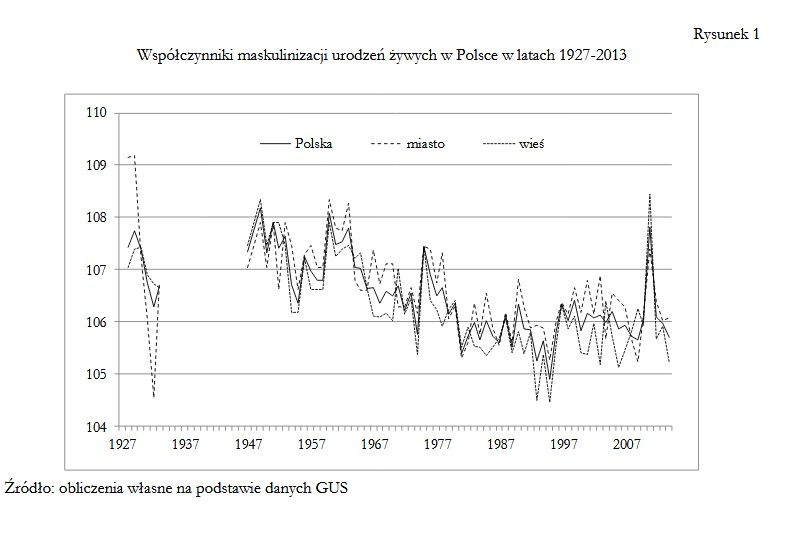
Fig.1 Masculinization rates for live births in Poland in 1927-2013
Chart source: Piotr Szukalski, Birth report of boys and girls,
http://dspace.uni.lodz.pl:8080/xmlui/bitstream/handle/11089/5325/2014-
08%20Sex%20ratio.pdf?sequence=1
The above graph of masculinization coefficient – sex ratio in Poland, in the period of several dozen
years, from pre-war Poland to the present day, indicated a strong advantage of boys’ births in pre-
war Poland (indicating better feeding of mothers), during the period of the PRL the constantly
decreasing masculinization coefficient indicating worse nutrition of Polish mothers, and finally, the
growing masculinization ratio which proves better nutrition of contemporary Polish society and
Polish mothers. The conclusions drawn from the observation of the above chart confirm the results
of my research proving that it was the climate crisis of the 70. XX century and the global increase in
food prices that influenced the revolutionary attitudes of malnourished Polish society. Failure to
fulfill the basic duty of the PRL authorities, which is agricultural policy conducive to adequate
nutrition of the society, and excessive and unprofitable food exports to the Soviet Union, caused
social protests and the Solidarity revolution.
An analysis of the masculinization – the sex ratio and other demographic indicators, as well as the
food situation of societies, can provide conclusions about the possible course of social moods, which
have usually surprised politicians until now. Conducting research on these issues can help preserve
peace of society and global peace. The war mechanism described in the following article indicates
that wars break out after an initial period of good nutrition of societies, in which the population is
growing with a strong predominance of young men, followed by a climate crisis and an increase in
food prices bring an increased level of social aggression. Unrealized procreation ambitions and sexual
stress associated with the difficulty of finding partners causes young men to be aggressive and favor
of politicians calling for war. This is only a step away from the aggressive behavior of entire countries.
The contemporary situation related to good nutrition of societies has been prevailing since the 1980s
and the masculinization rates of most countries of the world have probably increased during this
time. The climate crisis, which I forecast in the near future, will affect global aggressive pro-war
attitudes.
Will we be able to prevent them?
Warsaw, January 6, 2016 at 12:21 Bogdan Góralski
2 visits · 2 online
© 2023 JustPaste.it