


Contents
One cause of massive drought in Syria, Israel, China
Massive drought in Syria,Israel, China?
https://www.nature.com/articles/s43247-024-01603-4
https://www.bbc.com/news/world-asia-china-62644870
159 visits · 2 online
Why are the Sahara and Gobi deserts moving?
Why are the Sahara and Gobi deserts moving?
I found an interesting article on the Internet about the deserts in the African Sahara and the Asian Gobi and I quote it below:
Great Green Wall
https://gadzetomania.pl/wielka-sztuczna-rzeka-siedem-baltykow-pod-sahara,6731920095628000a
In the context of the Great Man-Made River, another impressive trans-Saharan project is also worth mentioning: the Great Green Wall. This initiative, launched in 2005, involves 11 African countries from the Sahel region – a belt of dry savannahs separating the Sahara Desert to the north from the partially wooded areas to the south.
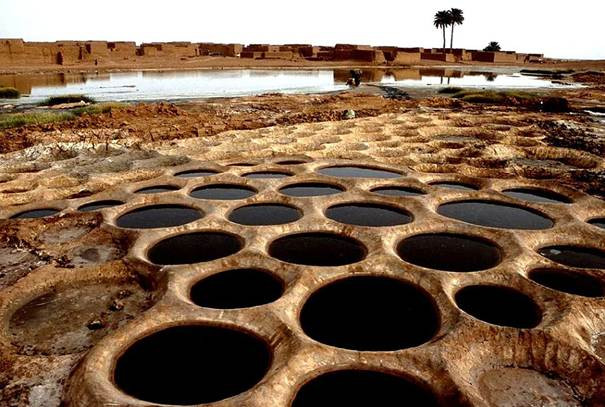
A gigantic reservoir of water beneath the Sahara. It’s like seven Baltic Seas.
The Great Green Wall is a belt of artificially planted trees and shrubs approximately 15 kilometers wide and over 7,700 kilometers long. This vast, man-made forest is intended to stem the southward movement of the Sahara Desert and protect the zone of naturally occurring trees, as well as agricultural land , from desertification .
Although the effectiveness of the Great Green Wall is disputed, a similar initiative, called the Green Wall of China, was also launched in China to protect against the expansion of the Gobi Desert. End of quote.
My comment on the alleged southward shift of the Sahara Desert into the Sahel countries is that this is due to the southward movement of the earth’s crust in the African region. The Sahara Desert is located in the year-round dry zone between the 20th and 30th parallels, and as the earth’s crust moves southward in the African region, the dry zone between the 20th and 30th parallels shifts obliquely into Sudan in eastern Africa and Algeria in the west. The earth’s crust likely moves symmetrically about the 100th meridian, southward along the 100th meridian West, and northward along the 80th meridian East. Accordingly, the Sahara should move northward in the Algerian region and southward in the Sudan region.
The movement of the Gobi Desert expanding into the territory of China is related to the movement of the earth’s crust in the Chinese region to the north so that the Gobi Desert is moving to the south.
In my book on the Earth’s climate mechanism entitled The new look at the Earth’s climate mechanism -link: https://books.google.pl/books?id=eZu-DwAAQBAJ&printsec=frontcover&source=gbs_atb&redir_esc=y#v=onepage&q&f=false
in the chapter 2.General causes of changes in climate and speed of rotation of Earth
is the explanation of the emergence of these facts.
The temperature of the interior of Earth is sustained by the constant friction between the COATING of Earth and its LIQUID OUTER CORE. The coating of Earth, consisting of the crust and the upper mantle, is rotating under the influence of the alternating gravitational field of the solar system and is rubbing against a liquid, metallic Earth’s outer core, which is a spherical sliding surface for Earth’s coating. Solid metallic inner core of Earth stay in the grip of the magnetic field of the Sun, which alternates according to the pulsation of gravity within the solar system. We see that the movements of the masses inside the Earth geoid are coupled with internal interactions within the solar system, which are also subject to the influence of our galaxy.
Changes in Earth’s climate (which are dependent mainly on the heating through the Sun the Earth surface) are an evidence that Earth’s coating moves in relation to its core. Climate change resulting from the tilt of the globe in relation to the ecliptic plane causing the succession of the seasons. On top of this there are circular movements of Earth’s coating around the axis of rotation of Earth and in relation to the ecliptic plane. Movements of the coating are mirrored by the apparent changes in the position of north magnetic field (see Fig.3), which is stable in the grip of the Sun’s magnetic field. Earth’s coating rotates but north magnetic field is motionless. During the duration of several thousand years, the magnetic poles traveled seemingly on the moving surface of Earth along a curve surrounding geographical pole. Deviations of the north magnetic pole from the north geographic pole reach over twenty degrees of latitude, ie . approximately 2500km and change over time (probably) on a regular basis , i.e. determined by cyclical interactions within the solar system. The research of paleomagnetism show deviation of the northern magnetic field from the north geographic pole (the axis of rotation of Earth) mirror the movements of Earth’s coating in relation to the sun. Sometimes movement of Earth’s coating reaches this extent that magnetic poles reversing itself but only apparent.
Movements of Earth’s coating change the moment of inertia of the Earth, which causes the variations of the speed of rotation. Increase in the speed of rotation of Earth was observing in the time when the northern magnetic pole was close the north geographic pole, and vice versa, ie . for example, around year AD 1600 and nowadays. I believe that changes in Earth’s rotation speed reflects variability of the Earth’s coating movement in relation to center of Earth’s gravity and in relation to the sun.
Deviations of location of the northern magnetic pole NMP- from the north geographic pole over twenty degrees latitude, and the circular apparent motion of NMP around the geographic pole, mirror the movements of Earth’s coating which cause regional changes in Earth’s climate. The width of climatic zones designated by the seasons on Earth’s surface reaches about 5 to 20 degrees latitude. Related to these zones, rainy and dry climates, which are dependent on the latitude and insolation, move along the surface of Earth, together with Earth’s coating movements, which are cyclical relative to the Sun. If the coating of Earth moves about 2500 km which is about 20 degrees latitude, climate zones shift respectively on the Earth’s surface. In such case, a given region of Earth can experience a dry season instead of rainy season, and vice versa.
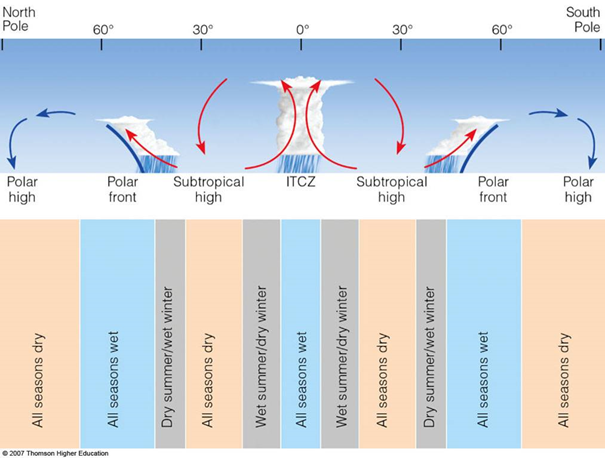
The “rising” and “sinking” zones move northward and southward together according to the Earth’s coating movements. Thus, the wet area near the Equator moves northward into the Northern Hemisphere in its summer, and southward into the Southern Hemisphere during its Southern summer. similarly, the dry zones and wet zone at higher latitudes shift northward and southward throughout the year.
The result of these shifting climatic zones are latitude bands with distinctive precipitation characteristics described below:
0–5° latitude: wet through the year (rising zone)
5–20° latitude: wet summer (rising zone), dry winter (sinking zone)
20–30° latitude: dry all year (sinking zone)
30–50° latitude: wet winter (rising zone), dry summer (sinking zone)
50–60° latitude: wet all year (rising zone)
60–70° latitude: wet summer (rising zone), dry winter (sinking zone)
70–90° latitude: dry all year (sinking zone)
Source of above data:
Global Distribution of Precipitation- link:
http://www.waterencyclopedia.com/Po-Re/Precipitation-Global-Distribution-of.html#ixzz4Bj24W4Vx
Debilitating floods in the Sahel are becoming frequent
Author links open overlay panel Nadir AhmedElagib a
Islam Sabry AlZayed b Suhair A.GayoumSaad c Mohamad IbrahimMahmood d MohammedBasheer e Andreas H. Fink f
https://www.sciencedirect.com/science/article/pii/S0022169421004091
Sahara ‘moving north’
https://www.theportugalnews.com/news/sahara-moving-north/43959
A national leading expert on climate change has warned that the Iberian Peninsula might soon be facing spells of droughts that could span up to eight years, as Portugal’s climate becomes increasingly like the arid climes of Northern Africa.
in News · 23 Nov 2017 · 4 Comments
Respected professor and researcher Filipe Duarte Santos this week forecast that, because of the advancement of the deserts in northern Africa, Portugal’s climate is becoming more and more like that of Morocco, Algeria or Tunisia.
His comments were made just days before Portugal was enshrouded by a mass of sticky warm air traveling upwards from south of the Canary Islands, pushing thermometers up by a good few degrees on Thursday and Friday.Duarte Santos, a professor at the Lisbon University of Sciences and head of the National Environmental Council, was speaking at a round-table event in Évora on Wednesday, on adaptation to climate change.The gathering was held as part of a National Meeting of Water and Sanitation Entities (ENEG 2017), which brought together hundreds of specialists on water.The expert stressed how the changing climate could have a bearing on the country’s water sector, stressing: “Climate change can be seen in the broadening of the tropical climate zone; the desert is being pushed north. It is essential in the water sector to take this climate change into account.”Expanding on his comments, he added that as Portugal is “an aged country, it is not easy for people to accept that this country is altering and that the climate changes.”The leading researcher, who spearheaded one of Portugal’s foremost climate change projects – the Scenarios, Impacts and Adaptation Measures (SIAM) project – further warned that the country’s irrigation systems in the medium and long-term may not be feasible.One suggestion he put forward is to transfer cork oaks trees to the north of the country.“Science shows that cork oak forests will not survive”, he said, explaining that it will not be diseases that kill them off, but a lack of water, which will extinguish the trees in the Alentejo.To maintain cork production, he said, “It would be practical to help the species settle in higher altitudes and move them north”, even if to the locations that this year were affected by the fires.Carlos Pinto de Sá, Mayor of Évora Council, the Alentejo’s largest city, said he would prefer to take a “global view” on the matter, stating that when faced with a “planetary and structural problem, the responses have to be planetary and structural because they are not solved at a local or national level”, though he added this does not mean that local authorities cannot play a role in solving problems.Meanwhile, Portugal’s environment minister, João Pedro Matos Fernandes, said at that same meeting that the possibility of having to ration water in Portugal due to the present state of drought is no more than “a theoretical hypothesis”.He believed that it makes no sense to think about such measures at this point, because they should be only a last resort.The minister was responding to questions from journalists prompted by comments from his own secretary of state, Carlos Martins, in an interview with the newspaper ‘ i ‘ published on Tuesday, in which the state secretary suggested the government could introduce water rationing at night.
In a nutshell, Minster Fernandes effectively dismissed that idea.“Rationing measures are at the very end of the end of the line, and it makes no sense to think of them now,” he said, adding: “We’re doing all [we can] so that there are no water shortages, together with local authorities, and it is fundamental that people save water.”The government has instead repeatedly called on people to use less water, and has said it is committed to ensuring that it will always be available.Nonetheless, on Thursday, Minister Fernandes did admit the price of water may go up due to the shortage.Portugal has been in a state of moderate to extreme drought for weeks.Just last week it transpired the rain that fell during the first half of November was less than a quarter of the usual average.Between 1 and 15 November, just 24 percent of the usual measurements fell in Portugal and the Met office forecast that the state of drought would endure at least until the end of this month.
However, with rainfall, in places heavy, expected to fall throughout Portugal over the weekend and the start of the coming week, it remains to be seen whether it will be enough to provide some relief from the drought-stricken country, and whether it will answer the Met Office’s prayers for a “November miracle.”
Portugal, which eliminated hard coal from electricity production in 2021, is having to import more electricity from Spain due to drought. This electricity is generated in coal-fired power plants.
Warsaw, January 30, 2022, 5:40 p.m. Bogdan Jacek Góralski
164 visits · 1 online
© 2025 JustPaste.it
© 2025 JustPaste.it
31 visits · 5 online
© 2025 JustPaste.it