

Contents
The long‑standing disputes between idealists and materialists about the nature of the world are neutralized by my theory, which is confirmed by facts established by many independent scholars.
A satisfactory materialistic doctrine would have to describe precisely the sequences of events occurring in matter that generate a given idea (Mises 2011:57).
The sequence of material events described below results in the emergence of successive ideas that affect the material world and create material consequences in that world.
7.1. The mechanism of the outbreak of wars and revolutions
The outbreaks of social conflicts and the formation of new ideas – new ethical systems – are caused by the following natural–material cycle:
The Sun acts on its planets through gravity and magnetism. Gravitational forces attract the planets to the Sun, and magnetism changes its intensity in the rhythm of the Sun’s pulsations, which occur when the centre of mass of the Solar System changes position. The position of the centre of mass of the Solar System changes in accordance with the changing positions of the planets around the Sun. The Earth’s core, moving within the Earth’s fluid interior, changes its position inside the planet, which alters the Earth’s moment of inertia and produces changes in the Earth’s rotational speed. At the same time, the Earth’s shell rotates around the inner core, above the liquid outer core, under the influence of gravitational forces. This is evidenced by the secular movements of the Earth’s climatic zones, the shifts in the positions of the magnetic poles, and the long‑term changes in LOD – the length of the Earth’s day. This causes deformations of the Earth’s crust, creating stresses that result in earthquakes.
Changes in the Sun’s magnetism and variable gravity within the Solar System thus produce fluctuations in the Earth’s rotational speed (LOD – length of day) and, in parallel, changes in the Earth’s climate, in accordance with the mechanism described below:
- Displacement of the Earth’s shell relative to the plane of the ecliptic and changes in the position of the climatic zones of the Northern Hemisphere; change in the planet’s moment of inertia and a decrease in rotational speed; tensile deformations stretching the globe along its axis; increase in stress in the Earth’s crust; increase in the number of earthquakes; intensifying upwelling (as a result of the inertia of the ocean waters responding to changes in the planet’s rotational speed); increasing biological productivity of the ocean and a rise in the emission of cloud‑forming sulphate aerosols in the oceans; increase in cloudiness over the oceans; cooling and humidification of the climate; increase in agricultural productivity in equatorial regions and a fall in food prices (in the Northern Hemisphere a decline in agricultural productivity) leads to a sudden increase in population and its masculinization in equatorial regions, and in the Northern Hemisphere to overpopulation and an economic and social crisis.
- Return movement of the Earth’s shell around the core towards a position of greater insolation of the Northern Hemisphere; reverse shift of climatic zones relative to the ecliptic; change in the planet’s moment of inertia and an increase in rotational speed; compressive deformations that “swell” the globe along its axis; decrease in stress in the Earth’s crust; decline in the number of earthquakes; reduction of oceanic upwelling driven by inertial forces, of biological production, and of the emission of cloud‑forming aerosols in the oceans; decrease in cloudiness over the oceans; warming and drying of the climate; decline in agricultural productivity in equatorial regions and a rise in food prices (in the Northern Hemisphere an increase in agricultural productivity) lead to overpopulation in equatorial regions and, in the Northern Hemisphere, to a sudden increase in population and its masculinization.
- Regional decline in the satisfaction of basic needs resulting from regional climatic deterioration, producing social frustration; growing aggression among starving masses directed at satisfying basic needs; formation of revolutionary elites; aggression redirected against the old elites; need for a leader able to direct the revolution and for survival technologies necessary to overcome the ongoing crisis; need to formulate a new ethical–ideological system uniting people around the technology of surviving the crisis; redistribution of the goods of the old elites to the masses of the poor; exhaustion of the possibilities of the revolution to improve the lot of the masses; overpopulation continues to make itself felt and the new elites seek a rescue plan for the impoverished masses.
- Migration resulting from continued overpopulation, or military aggression against neighbouring territories, treated as a way out of a difficult economic and food situation, leads to a reduction in population density (war losses plus territorial gains reduce the aggression of the male part of the population) and to the calming of public moods.
The displacements of the Earth’s core and shell are strongly influenced by the gravity of the Moon, which is twice as strong as the gravity of the Sun. The mechanism described above should be modified by taking into account the variable gravitational influence of the Moon and the planets of the Solar System.
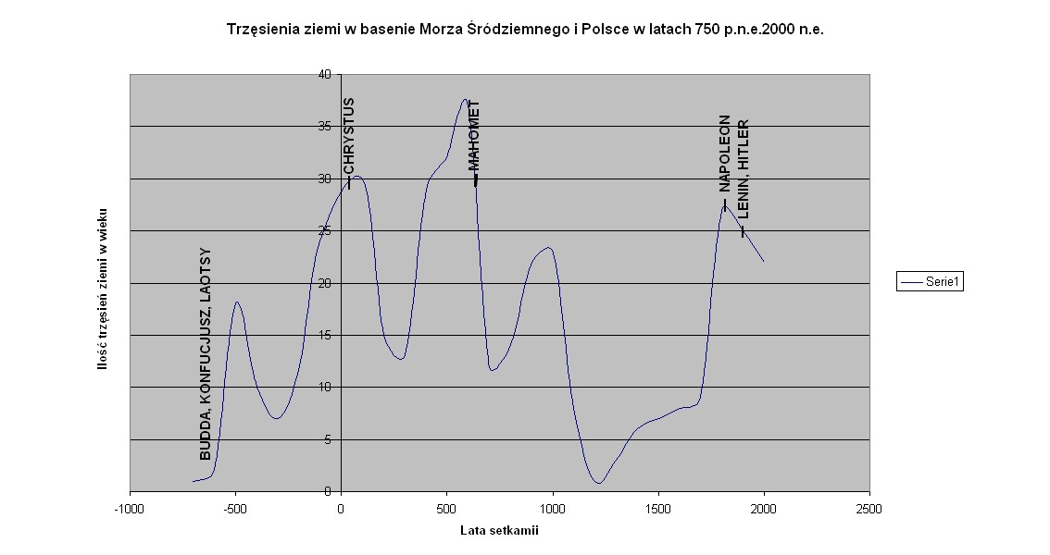
Figure 34. The gravity–magnetic–seismic–climatic–social cycle. Source: Góralski 2009 (drawing by Bogdan Góralski)
The gravity–seismic–climatic–social cycle shown in Figure 34 characterizes the phases of development of our civilization over the centuries. All great leaders and ethicists appeared in a similar phase of the material cycle (Asian ethicists appeared in the opposite phase, which is explainable and consistent with my theory, as an effect of the climatic inversion between the West and the East of Eurasia). This was the result of successive climatic crises defined by cyclical changes in the geometry of the Solar System.
Each cycle followed a similar scenario of natural and social events and produced a similar ethical–ideological system, each time expanding the social base of the revolution. The crisis of the material world, which has begun to intensify in the 21st century according to the logic of history, will also bring forth a new, universal ethical system – new ideas that will probably encompass the entire global community.
The first known ethical system arose in Egypt and was recorded in the 42 commandments of the goddess Maat. It was an expression of the development of the social system of a populous state prospering in the rhythm of the Nile’s floods. The ethical system of Moses, educated in Egypt, was derived from Egyptian ethics. Asian ethicists appeared at the end of a period of overpopulation and of global climate warming and drying, because the demographic development of Asian societies proceeded rapidly during a period of good water supply in Asia and led to a socio‑economic crisis resulting from overpopulation. Asian societies reached a critical population density, which forced the creation of a new ethical system regulating social relations.
The 6th century BC was the peak of China’s power. The beginnings of the construction of the Great Wall to defend against Mongol invasions, significant territorial expansion to the north and south, and the growth of the population to 25 million are examples of this power. The Great Greek colonization in the 8th–6th centuries BC shows that during this period Greece and the equatorial world enjoyed environmental conditions favourable to population growth. These data make it possible to suppose that in the 8th–7th centuries BC the population of the equatorial world increased. After a period of population growth, there was a drastic drying of the climate (a decline in the number of earthquakes in the 7th century BC, see Figure 34), causing overpopulation and conflicts. This resulted in the almost simultaneous emergence of the ethical systems of Buddha, Laozi, and Confucius, which facilitated the resolution of social conflicts in the then overpopulated India and China.
The phase of increasing earthquakes in the 200 years before Christ was accompanied by heavy cloudiness and thus by high precipitation. This is confirmed by studies (Lamb 1977:426–427, graphs 17.1 and 17.2) of the Nile floods and of floods and wet years in Rome. These studies indicate strong climatic humidity in Africa around Egypt and in Italy at that time. This favoured increased agricultural production and, consequently, good food supply for the population. During the reign of Herod the Great (73–4 BC) Palestine experienced favourable economic development, as evidenced by urban growth and the wealth of the ruler. This indicates a large population (Theissen 2004:60). Abundant food favoured population growth in well‑watered areas.
After a period of demographic growth in Palestine, there was a rapid global warming and drying of the climate from AD 0–10 (Bao et al. 2002; Kobashi et al. 2011; Lamb 1977:426–427) which reduced agricultural production and food supply, causing overpopulation in Palestine. The violent socio‑economic crisis caused by drought (Lamb 1977:426–427, graphs 17.1 and 17.2) generated frustration among the population (particularly rural), which sought a way out of the crisis. Socially uprooted groups tested various ways of escaping the crisis. The starving rural masses needed a plan of action to alleviate the supply problems widespread at that time.
Many leaders appeared, among them Jesus Christ, who had an anti‑crisis plan of action. He created his communities (the Acts of the Apostles describe communities numbering several thousand people (Bible 1998: Acts 2:41; 4:4)), which functioned like communes. To join them, one had to offer all one’s property. The communities, managing the donated wealth efficiently, provided protection against hunger and lawlessness then prevailing in Palestine. At that time there were numerous bands of robbers. Many farmers were hopelessly mired in debt (Johnson 1993:146). Christ, feeding crowds of the poor, became a dangerous leader of the masses in the eyes of the authorities. His economic and social program was radical and unacceptable to the then elites of Judea. Christ, the leader of a peaceful popular movement, was killed, and later armed Jewish protests against Roman oppression lacked a charismatic leader.
In the period from the 1st century BC to the 1st century AD there was a strong density of farms in Judea and Samaria. This indicates climatic conditions favourable to the fragmentation of farms – good water supply in the 1st century BC. The sudden drought at the beginning of the 1st century AD caused the collapse of these small farms and a crisis situation. The uprising in Palestine in the years 66–74 AD had the character of a social revolt against the rich. The revolt began with the burning of the Roman tax registration offices in Jerusalem (Sartre 1991:403). The catastrophe of the Jewish uprisings revealed continuing overpopulation, and their consequence was the destruction of the country. There followed a mass migration of Jews.
From the beginning of the 7th century there was strong climate warming – signalled by a decline in the number of earthquakes – which ultimately caused the transfer of civilizational centres from the Near East to, among others, the cooler Europe and Mesopotamia. Warming and drought caused a regression in the development of equatorial populations. Overpopulation occurred on the Arabian Peninsula before Muhammad’s victory. Population growth probably took place in the 4th, 5th and 6th centuries, during a period of cooling and increased moisture in the climate, in parallel with the fall of the Western Roman Empire, into which barbarian tribes migrated from northern territories that were overpopulated (populations of barbarians north of the Roman Empire probably grew in the 2nd and 3rd centuries) due to unfavourable weather conditions. Under the pressure of this great barbarian exodus to the south, the Western Roman Empire collapsed. While the economic crisis of the Western Roman Empire lasted, the excellently organized economic and social Christian communities were in their heyday, which led to the success of Christianity and the consolidation of its power. The Eastern Roman Empire, meanwhile, prospered remarkably well.
The escalation of aggression and fratricidal struggle on the Arabian Peninsula prompted Muhammad to reflect on the causes of this state of affairs. Muhammad rejected the social order proposed by the old elites; he introduced a new supra‑tribal religious community – the umma – and the obligation of almsgiving, that is, the redistribution of goods to the poor. Fighting with other leaders, he united all the Arab tribes. He broke with the clan system. However, his economic program could not solve the problem of overpopulation (Hrbek, Petráček 1971:139–140); therefore a military expansion of the Arabs followed. This was possible because in the 7th century the power of the Roman Empire had diminished, while the strength of the Arabs, united by the ethical system created by Muhammad, had increased.
The warming and droughts from the 7th century caused regression in the development of equatorial populations and their movement northwards, whereas societies in the Northern Hemisphere began to develop civilizationally. In the favourable conditions of the warm climate of the so‑called third Subatlantic (Samsonowicz 1990:8), there was a dynamic development of European civilization and of the state organization of Germanic and Slavic tribes.
From 1700 the population of Europe grew, but bad weather conditions and population growth in the 17th and 18th centuries worsened the situation in England and France. England, however, had a safety valve in the form of emigration to the colonies. The food situation of French society deteriorated from 1700 (Livi‑Bacci 1991:82). The French protected themselves from hunger by establishing several hundred thousand small farms (Taine 1881:337). Before the French Revolution there was a significant cooling of the climate (Bradley, Jones 1993), which brought high food prices to France (Góralski 2012:28), hunger, and the outbreak of revolution. The revolution continued, and the problems of overpopulation did not disappear because of further cooling of the climate. Another revolutionary leader, Napoleon, led the French to conquer Europe, which solved the problem of surplus single men who had no conditions in France at that time to start families.
From 1815 the climate warmed and dried, which caused Europe’s population to grow in the 19th century from 203 to 408 million, and by 1950 to 547 million. There was a huge increase in the German and Russian populations. Russia and Germany at the beginning of the 20th century were heavily overpopulated, which led to the catastrophic development of totalitarian systems that centralized societies around new leaders. Overpopulation, masculinization of the population, high food prices caused by cooling of the climate at the beginning of the 20th century (Góralski 2012:8), and the lack of possibilities to solve food and economic problems by peaceful means led to the First World War, the Russian Revolution, and the warlike expansion of communist Russia towards Western Europe in 1920 (Góralski 2012). The Second World War was a consequence of the First World War and of the conditions of the Treaty of Versailles, as well as of a short‑term climatic cooling. High food prices in China at the beginning of the 20th century led to the Chinese Revolution, which, later using Marxism, caused the decline in importance of the landowners who had previously taken over most of the arable land.
From 1960 to 1990, during a short‑term cooling and moistening of the climate (see Figure 30), Africa’s population grew from 282 to 637 million, and China’s population increased rapidly from 583 million in 1953 to 1,008 million in 1982. At that time, the Northern Hemisphere experienced economic difficulties as a result of cooling and declining agricultural production, which led, among other things, to the collapse of the Soviet empire and to an almost revolutionary situation in China (Gang 2001:37–38; Gawlikowski 2001:388). The revolution broke out because of the enormous population growth and rising food prices, and consisted in peasants dissolving rural communes and allocating land to individual families. This led to a huge increase in agricultural production and to China’s current food self‑sufficiency.
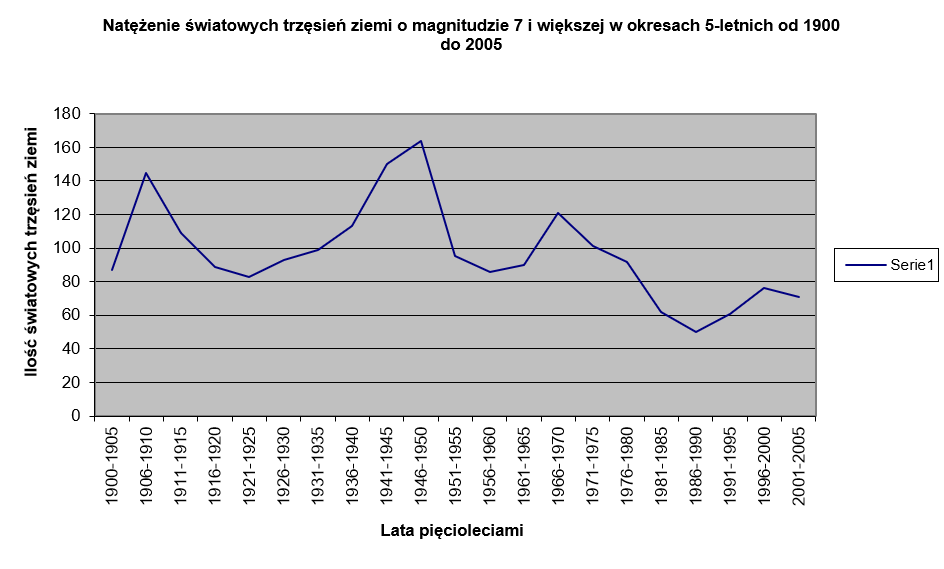
Figure 35. Global seismic activity characterized by earthquakes of magnitude M = 7 and greater in the years 1900–2005 (five‑year periods). Source: Góralski 2009 (drawing by Bogdan Góralski)
The graph in Figure 35 confirms the occurrence of cooling in the years 1960–1990, since it is accompanied by an increase in the number of significant earthquakes.
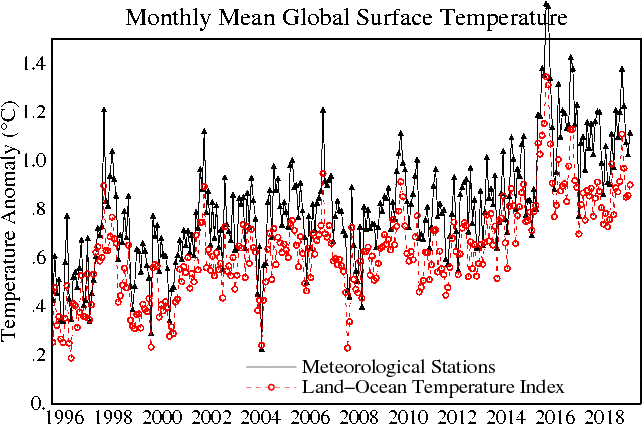
At present warming is continuing (the number of earthquakes has declined), which is causing growing aggression in Asia and Africa – aggression resulting from declining per capita agricultural production in populations with many young males, and from worsening living conditions caused by rising world food prices. Migration from these continents to the USA and Europe is increasing. At the same time, in the G‑8 countries there is agricultural overproduction combined with a decline in population size. There is no market for this surplus because of the poverty of potential buyers. All this together is causing a financial and economic crisis. The logic of history allows us to expect the appearance of an outstanding figure, the creator of a new order and a universal ethical system, uniting humanity on the path out of the crisis. This leader will have to apply the message of Jesus Christ, who said: “Share bread in remembrance of me” (Bible 1998: Lk 22:19), and love your enemies, for this is what love of neighbour consists in.
If warming continues, it will worsen the situation in equatorial countries, and the migration wave to food‑rich countries will intensify (in 2011 there was a wave of riots and revolutions in North Africa and the Middle East caused by high food prices resulting from global cooling in 2010; see: https://jpcdn.it/img/aea296978ec6f63b142cb966c8d0984f.gif). If cooling comes, it will bring disaster (a reduction in food production) to the civilization of the white man, migrations from the G‑8 (or revolutions?) and a rapid further increase in population in equatorial countries. The world will not survive such a sequence of events and the situation will begin to destabilize. We must not allow this.
The barriers of our civilization in the face of the threat of climate change are:
- depopulation of Western industrialized countries,
- overpopulation of Asia and Africa and the resulting shortages of water, food, and energy,
- competition between ethical–religious systems prevailing in different societies,
- lack of cheap and large‑scale systems for transporting people and food.
7.2. Survival technology for the approaching climate crisis
The leaders of every revolution arising from the worsening satisfaction of a population’s basic needs have each time devised the same pattern of actions, the so‑called survival technology:
- tightening social bonds through a revolutionary ideology directed against the old elites, and creating a new ethical system;
- redistributing the wealth of the old elites to the frustrated masses;
- peaceful or warlike migration to less populated areas.
Christ, Muhammad, Napoleon, Hitler, and Lenin strongly emphasized the need to redistribute goods from wealthy elites to the masses of the poor. These were elements of a revolutionary ideology addressed to impoverished societies. This protected them from the anger of the masses and made them tribunes of the people. The anger of the crowds has always led to the elimination of the old elites, made up of people best adapted to the existing old system.
Today’s elites should fear a future revolution, because it may end in their annihilation. By virtue of having control over the apparatus of science, they should recognize future threats and counteract them. Instead, the current elites complacently pursue a disastrous strategy of stupefying public opinion and refuse to warn it against real dangers. The real dangers are climate‑driven agricultural and economic crises, wars, revolutions, and uncontrolled mass migrations, which in the past were responsible for the collapse of empires and the destruction of their elites.
What is survival technology?
Technology is the method of achieving a set goal, conditioned by the state of knowledge and by social efficiency (Lem 1974:32–33).
Our goal is to survive the approaching climate crisis; therefore we must acquire knowledge and social efficiency. We understand what it means to acquire knowledge, but what does it mean to be socially efficient? A socially efficient society must cooperate harmoniously so as not to waste its strength (energy) and to achieve the goal of survival effectively. It is a society with a high capacity for cooperation, an ethical society. Thus, social efficiency is based on social bonds. It rests on ethics, which conserves social energy (uses it well, does not squander it in conflicts) in achieving the goal of survival. The ethics of a society is a function of its knowledge.
A static society that does not counteract crises is exposed to revolutions. Every revolution unfolds in the same way – a revolt of citizens against worsening living conditions. There must be found someone to blame for the crisis situation – a victim of aggression – and this has always been the best‑educated social elites. From this follows the conclusion that today’s elites should create mechanisms for educating and enriching the poor masses in order to prevent the anticipated crises.
Our modern survival technology will consist in using the entire legacy of our civilization, and it will look as follows:
- mechanisms that guarantee everyone the opportunity to acquire knowledge and wealth, but in such a way that private hereditary property is not created;
- organizing peaceful migration of nations from overpopulated regions to Europe, Russia, and the USA;
- developing a unified ethical system.
We see that we must develop knowledge about social mechanisms and about mass means of transport in order to design policies for implementing the first two postulates. However, without a unified ethics that ensures harmonious cooperation of the global community, we will achieve nothing. A unified ethical system must arise for the entire world community, based on the universal principle of conserving all forms of energy, which will make possible close international cooperation.
Global climate changes have always caused social conflicts and mass migrations. They can be prevented only by the consistent implementation of a modern survival technology expressed by the equation:
KNOWLEDGE + ETHICS = ENERGY = LIFE
The use of knowledge and ethics will give effectiveness (energy) to our global actions. The limit of knowledge is wisdom, and the limit of ethics is love. May wise love between people ensure our highest effectiveness in overcoming the approaching climate crisis. This will secure a peaceful life for future generations.
Warsaw, 23 October 2011